P/E Ratio of a Stock: Understanding the Basics
Understanding the P/E Ratio

The P/E ratio, also called the price-to-earnings ratio or PER, is a metric used by financial experts to assess the value of a company's shares. The P/E ratio is a way to understand how much investors are willing to pay for each dollar of earnings.
The price-to-earnings ratio (P/E ratio) is determined by dividing the current stock price of a company by its earnings per share (EPS).
Let's say a company's stock is currently priced at $50 per share. If the company's earnings per share (EPS) for the past year is $2, then we can calculate its price-to-earnings (P/E) ratio. In this case, the P/E ratio would be 25, which is obtained by dividing the stock price ($50) by the EPS ($2).
The price-to-earnings ratio helps investors understand the amount they're spending for every dollar of a company's earnings. Investors pay more when the P/E ratio is higher because they anticipate higher earnings growth in the future. When the P/E ratio is lower, it means that investors are paying less for each dollar of earnings.
The Importance of the P/E Ratio
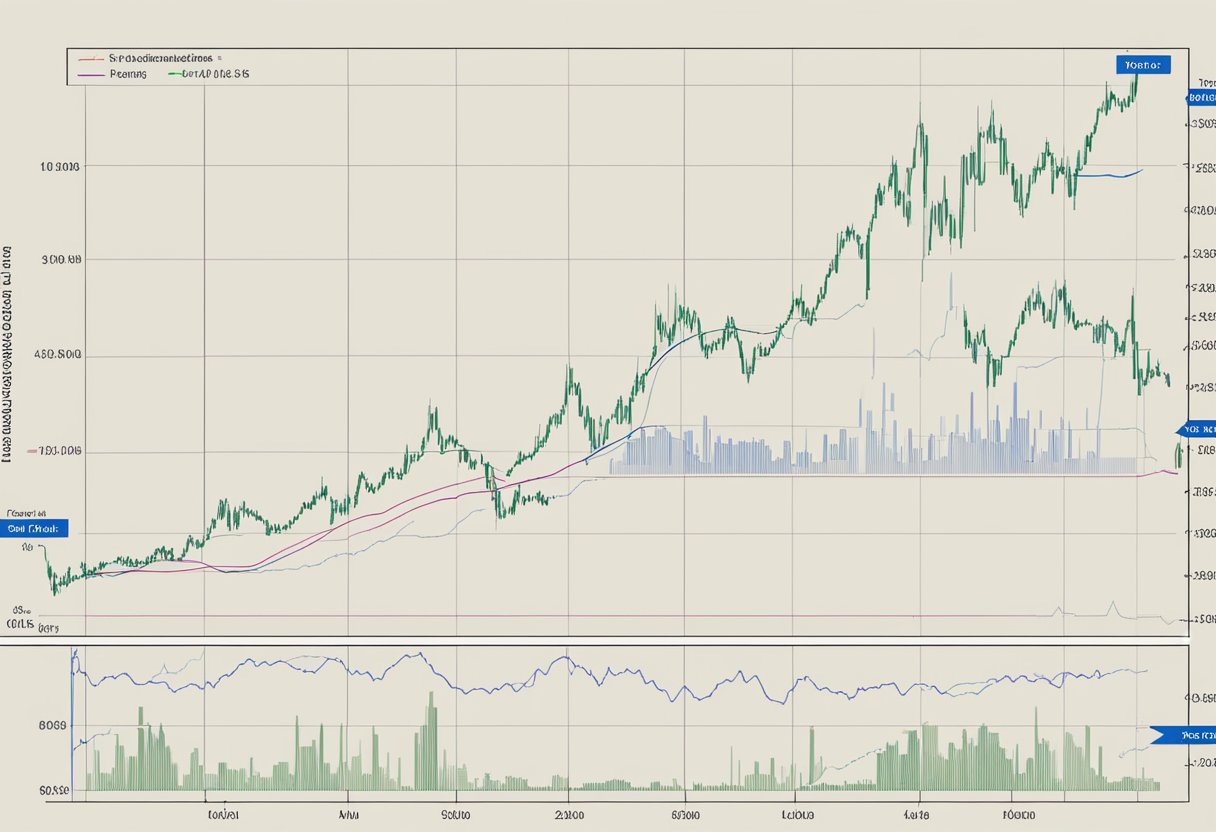
The P/E ratio is a key tool for investors to evaluate how a stock is valued and compare it to other stocks. Let me explain why the P/E ratio is a valuable tool:
Evaluates the Price-to-Earnings Ratio
The price-to-earnings ratio (P/E ratio) is a way to determine the value an investor is placing on a company's earnings per share. When the P/E ratio is high, it means investors are shelling out more money for every dollar of earnings. On the other hand, a low ratio indicates that they are paying less.
Investors can use the P/E ratio to determine if a stock is priced too high or too low compared to its historical averages or similar companies in the industry. The P/E ratio helps us understand a stock's share price by comparing it to the company's earnings.
Suggests Possible Over or Underpricing
A high price-to-earnings ratio suggests that a stock might be considered overvalued or that investors have high expectations for its growth. On the other hand, a low ratio might indicate that the company is undervalued or has limited growth potential.
By looking at a stock's current price-to-earnings ratio (P/E) and comparing it to its historical average P/E and other companies in the same industry, we can get an idea of whether the stock is potentially over or undervalued. Investors might consider purchasing stocks that are currently trading below their historical averages and industry standards.
Enables easy comparison between different stocks and industries.
Comparing the P/E ratio can help you evaluate stocks from different industries. Industries that experience rapid growth typically have higher average price-to-earnings (P/E) ratios compared to industries with slower growth.
By analyzing comparative P/E ratios, investors can pinpoint stocks that might be undervalued compared to other companies in the same industry, even if the P/E ratio appears higher overall.
Understanding the P/E Ratio for Stock Analysis

The P/E ratio is a handy tool for analyzing and comparing stocks. Here are some important ways it can be used:
When evaluating a stock, it's helpful to compare its price-to-earnings (P/E) ratio to its historical average. This ratio gives you an idea of how much investors are willing to pay for each dollar of earnings. By looking at the stock's P/E ratio in relation to its historical average, you can assess whether the stock is currently overvalued or undervalued. This simple comparison can provide valuable insights into the stock's potential for future growth.
Examining the current price-to-earnings (P/E) ratio of a stock in relation to its historical average P/E can offer valuable insights into whether the stock is potentially overpriced or underpriced compared to its usual valuation range. If the current price-to-earnings ratio is much higher than the average in the past, it could suggest that the stock is too expensive. On the other hand, if the current P/E ratio is much lower than what it has been historically, it might indicate a chance to buy a stock at a lower price than it's actually worth.
Let's take a look at the price-to-earnings ratios of different companies in the same industry.
When you compare a stock's P/E ratio to other companies in the same industry, it can give you a good idea of its value. To determine if the stock is expensive or cheap compared to similar companies, you can compare its P/E ratio to the industry average or to direct competitors. It's important to note that various industries have significantly different typical price-to-earnings (P/E) ranges.
Spotting Stocks That May Be Overpriced
When a company's stock has a very high price-to-earnings (P/E) ratio compared to its historical norms or the average for its industry, it could mean that the stock is overvalued and might be due for a correction. Investors can use a simple method to find stocks that may be overvalued by looking at their price-to-earnings ratios. However, it's important to also take into account factors such as growth projections. This is because stocks with high growth potential may justify having higher price-to-earnings ratios.
Spotting stocks that may be undervalued
On the other hand, stocks that have low price-to-earnings ratios compared to their historical averages or other companies in the same industry might be good investment options that are worth looking into. Look for stocks with price-to-earnings ratios below specific benchmarks to identify potential value opportunities. However, it is important to ensure that the low price-to-earnings ratio (P/E) is reasonable and not a result of any underlying issues within the company.
Drawbacks of the Price-to-Earnings Ratio

Although the P/E ratio is widely used to evaluate stocks, it does have a few drawbacks that investors should keep in mind:
Earnings can be easily manipulated.
The earnings figure in the P/E ratio can be easily manipulated by using accounting tricks or making changes in business practices. If the earnings are overstated, it can make the P/E ratio less reliable.
This analysis does not take into consideration the potential for future growth.
The P/E ratio is a metric that looks at historical earnings and the current price of a stock. It's important to consider future earnings growth when evaluating a stock's P/E ratio. Sometimes, a high P/E ratio might make a stock appear overvalued, especially when there is strong growth expected.
Differences are significant depending on the industry
P/E ratios can differ significantly between industries. It can be challenging to compare different things. A tech stock with a price-to-earnings ratio of 30 might not be considered overvalued when compared to similar companies in the industry. However, a utility stock with the same P/E ratio would be considered to be on the higher end of its valuation.
Does not consider the potential risks associated with the balance sheet, such as debt levels.
The P/E ratio focuses solely on the information provided in the income statement. It doesn't take into account important factors such as a company's debt or cash position, which can affect the quality of earnings and risk level.
Understanding the Significance of a "Good" P/E Ratio
Determining whether a P/E ratio is considered "good" or not is not a straightforward matter, as it is influenced by various factors. However, there are a few basic principles to keep in mind:
P/E ratios between 15-20 are generally considered to be reasonable by financial experts. - A P/E ratio between 15 and 20 is generally seen as reasonable for companies that have moderate growth and operate in mature industries. This average from the past can be used as a starting point for making comparisons.
Stocks that experience high growth often have higher price-to-earnings ratios (P/Es). - It's pretty normal for stocks that are expected to grow well to have P/E ratios above 20 or even 30. The reason for the high valuation is because the market expects the company to grow significantly in the future.
Low price-to-earnings ratios can be a sign of financial difficulties or limited potential for growth. - When the price-to-earnings ratio (P/E) of a stock is below 10, it might be considered undervalued. However, it's important to note that a low P/E could also be a sign of issues such as diminishing future prospects, financial difficulties, or potentially misleading accounting practices.
Take a look at how the numbers stack up against past performance and other companies in the same industry. - Two good benchmarks to consider are the stock's historical average price-to-earnings ratio and the average for the industry. Take a look at how the stock compares to its competitors to determine if it is priced higher or lower compared to similar companies.
Using the P/E Ratio: Effective Strategies
Investors and analysts can use the P/E ratio to evaluate stocks in different strategic ways.
Find stocks with low price-to-earnings (P/E) ratios: A common way to utilize the P/E ratio is to identify stocks with lower P/E ratios in comparison to their historical averages or industry counterparts. Companies with low price-to-earnings ratios might be undervalued by the market and could have the potential to increase in price. Investors can look for stocks that have a price-to-earnings ratio (P/E) lower than a certain threshold, such as 15 times earnings. This can help them find potential value opportunities.
Consider using additional valuation metrics to enhance your analysis: Using the P/E ratio is helpful, but it becomes even more effective when combined with other valuation metrics such as the price-to-book ratio, EV/EBITDA, dividend yield, and so on. When we compare multiples, we get a better overall picture of how a stock is valued and it helps us overcome the limitations of using just one ratio.
Let's talk about the difference between forward and trailing P/E ratios: The trailing P/E ratio looks at the earnings data from the past year, while the forward P/E ratio is based on the estimated earnings for the next year. Forward price-to-earnings ratios can be helpful when deciding where to invest. They take into account a company's projected growth and provide valuable insights. By comparing trailing and forward price-to-earnings ratios, we can determine if the market has already factored in future growth.
Incorporate earnings growth by using the PEG ratio. The PEG ratio is a useful tool that takes into account the expected earnings growth to provide a more comprehensive understanding of a company's valuation. If a stock's PEG ratio is below 1.0, it suggests that the market may be undervaluing its potential for future growth. When it comes to investing, it's important to prioritize stocks with low PEG ratios instead of solely looking at low P/E ratios.
Real-Life Scenarios and Illustrations
Examining stocks through the P/E ratio can offer valuable insights into their value. Let's take a look at a few examples of how to evaluate stocks using the P/E ratio:
Examining Technology Stock with a High Price-to-Earnings Ratio
Technology stocks tend to have higher price-to-earnings (P/E) ratios than the overall market. This is because investors anticipate greater growth from these companies. Take Company XYZ as an example. It's a big tech company that's currently trading at a trailing P/E ratio of 30, which is significantly higher than the market average of 15-20. Investors have high expectations for earnings growth, which is reflected in the high P/E ratio. To determine if the high valuation is justified or a sign of overvaluation, we need to consider other important factors such as revenue growth, margins, and competitive position.
Assessing Cyclical Stock with Forward P/E Ratio
Industrial manufacturers, like cyclical stocks, can experience fluctuating earnings throughout the business cycle. When it comes to these stocks, it's helpful to consider the forward P/E ratio, which takes into account estimated future earnings. This can give you a clearer idea of their valuation. Let's take Company ABC as an example. It's an industrial stock that currently has a trailing P/E ratio of 10. However, its forward P/E ratio is only 8, which indicates that there is an anticipated increase in earnings. Based on the low forward P/E ratio, it seems like the stock might be priced lower than its actual value.
Comparing P/E Ratios in the Same Industry
When you compare a stock's P/E ratio to other companies in the same industry, it can give you an idea of whether the stock is overvalued or undervalued compared to its peers. As an example, let's take a look at Company DEF. Its price-to-earnings ratio (P/E) is 12, which is lower than the average P/E of 16 for other companies in the same industry. Based on the growth rates of similar competitors, it seems that Company DEF might be undervalued.
Understanding the Effect of Earnings Manipulation on Price-to-Earnings Ratio (P/E)
The P/E ratio is influenced by changes in earnings, which can be affected by temporary increases or decreases. Let's take an example: Company GHI saw a significant increase in its earnings per share (EPS) in the past year because of a one-time sale of assets. The price-to-earnings ratio decreased from 22 to 12 as a consequence. However, based on future projections, it is anticipated that earnings will return to their usual, lower levels. Based on the current situation, the low price-to-earnings ratio doesn't accurately reflect the actual value.
Common Questions

Hello there! What is considered a favorable price-to-earnings (P/E) ratio?
Determining what is considered a "good" P/E ratio can be quite subjective, as it depends on factors such as the industry and growth projections. Typically, a P/E ratio of 15-20 is seen as reasonable for well-established companies. Companies that experience significant growth are often able to support higher price-to-earnings ratios. It's helpful to consider a stock's P/E ratio in relation to its historical average and other companies in the same industry. This can give you a better understanding of the stock's value.Sure, I can help you with that. Would you prefer a higher or lower P/E Ratio?
Typically, value investors seek out stocks with low price-to-earnings (P/E) ratios, while growth investors are more willing to consider stocks with higher P/E ratios. On one hand, a low P/E ratio might indicate that there's not much room for growth. On the other hand, a very high P/E ratio means that there are high expectations and potential risks involved. It's best to look for stocks that have the potential to grow and are reasonably priced.Hello there! What does a high or low price-to-earnings (P/E) ratio indicate?
When the P/E ratio is high, it means that investors believe the company will grow a lot and are willing to pay more for its earnings. On the other hand, it suggests that the stock might be priced too high. A low price-to-earnings ratio suggests that the stock may be undervalued, but it could also mean that there are issues with the quality of earnings or the potential for growth.Hello there! Let's talk about the limitations of the P/E ratio. It's important to understand that while the P/E ratio is a widely used financial metric, it does have its drawbacks. One limitation is that it only considers the earnings of a company and doesn't take into account other factors such as debt, cash flow, or future growth prospects. Additionally, the P/E ratio can vary significantly across industries, making it difficult to compare companies in different sectors. It's also worth noting that the P/E ratio is based on historical
The P/E ratio doesn't take into consideration the potential for future earnings growth, the health of the balance sheet, or other qualitative factors. Accounting tricks can be used to manipulate earnings. The P/E ratio can differ significantly between different industries, which means that making direct comparisons can be misleading. It's important to consider this metric in conjunction with other factors.In summary
Simply put, the P/E ratio is a handy tool for evaluating a company's stock price in relation to its earnings per share. This information helps determine if a stock is priced higher or lower than its earnings potential. Here are some important points that are covered: -Comparing valuation across stocks and industries is made easy with the P/E ratio. A high price-to-earnings (P/E) ratio might indicate that a stock is priced too high compared to its earnings, while a low P/E ratio could suggest that the stock is potentially undervalued and could be a good investment opportunity. When looking at P/E ratios, it's important to consider how they compare to historical averages, other companies in the same industry, and the potential for future growth. It's important to keep in mind that the P/E ratio has its limitations. For example, it can be influenced by earnings manipulation. That's why it's a good idea to consider other metrics as well. Using strategies such as looking for stocks with low P/E values, considering forward P/Es, and factoring in growth with the PEG ratio can give you a better overall view.
When you use the P/E ratio correctly as part of a strong valuation strategy, it can help you spot stocks that might be priced incorrectly. However, it's important to remember that using it alone or without considering the company's industry and future prospects is not advisable. When analyzing stocks, it's a good idea for investors to consider the P/E ratio as one factor to help make informed investment choices.
In general, the P/E ratio can be a helpful tool for investors who focus on finding good value. However, it's important to have a good grasp of how to effectively use P/E ratios in different industries and growth scenarios. By understanding how to use P/E analysis strategically, investors can enhance their stock research capabilities.
Post a Comment